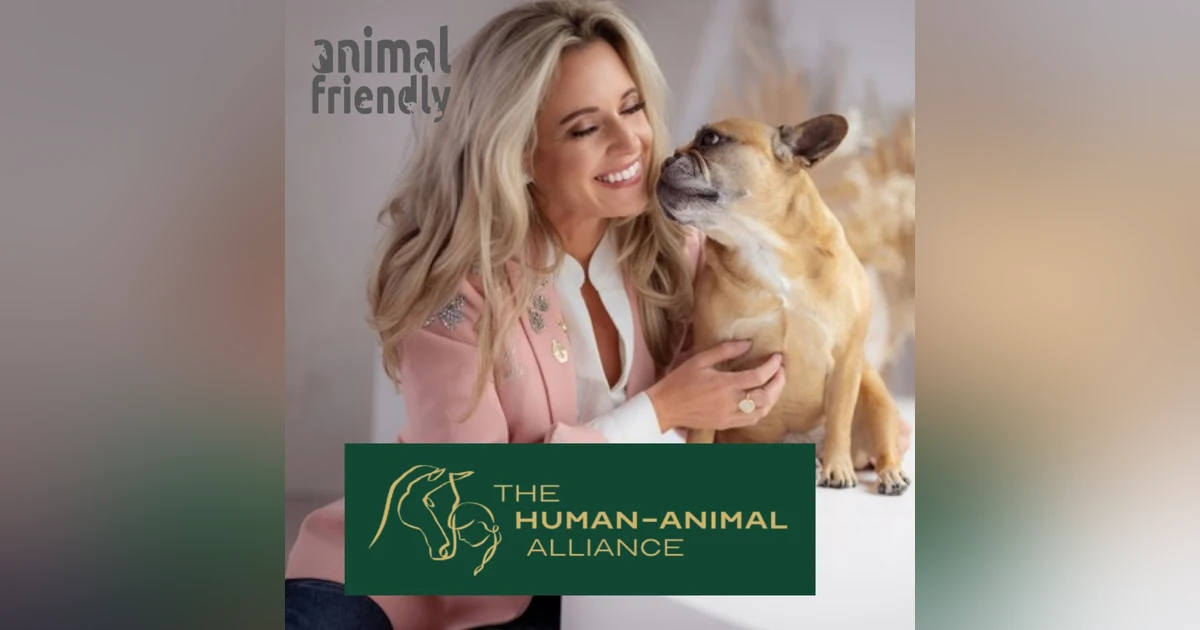
34. The Human-Animal Alliance

 Podchaser
 Spotify
 Apple Podcasts
 The Human-Animal Alliance is a hugely impactful organisation that raises funds to grant directly to programs that share their belief in the power and value of the human-animal connection.
Equine-assisted therapy, Pet Pantry programs, support for humans and animals affected by hurricanes or wildfires, summer-camp scholarships, trauma-recovery programs and much more: since 2022 the organisation has raised and granted over $400,000 to programs that they describe as truly exceptional yet often overlooked.
Jackie Ducci - advocate, philanthropist, equestrian - says that animals have provided life-changing support and friendship to her throughout her life and she wants to enable others to feel that same connection.
We talked about her journey to setting up The Human-Animal Alliance and delved into some of the programs they support. We also chatted about Unspoken Bond, a documentary which tells the stories of people whose lives were changed dramatically through their relationships with animals.
The Human-Animal Alliance website:
List of Past Grants of The Human-Animal Alliance:
Jackie's website:
The Unspoken Bond film - info and trailer.
Links to social media can be found on these websites.
Featured Music:
New Funk by Vlad Gluschenko | https://soundcloud.com/vgl9
Music promoted by https://www.free-stock-music.com
Creative Commons / Attribution 3.0 Unported License (CC BY 3.0)
https://creativecommons.org/licenses/by/3.0/deed.en_US
See omnystudio.com/listener for privacy information.
(Music playing)
HOST (Voiceover): What kind of feedback do you get from the donors about what you're doing?
JACKIE (Voiceover): The biggest thing is that they appreciate how thoroughly we vet the nonprofits that we grant to. That's a big thing because there are a lot of people who are very philanthropic or want to be more philanthropic, but the biggest thing they struggle with is like, I don't know where to give. Right? Because they get overwhelmed by how many organizations are out there and they don't have the time to do the vetting. So the fact that they can give to us and just know that that money is going to go to an amazing organization, it just takes that piece of the equation off the table for them. So it's super positive for them.
(Music playing)
HOST (Voiceover): Hello, and welcome back to the Animal Friendly Podcast. My guest today is Jackie Ducci, the founder of the Human Animal Alliance. This organisation raises funds to grant directly to programs that share their belief in the power and value of the human animal connection. They started about four years ago, and in that time, they have raised and granted over $400,000 to a wide variety of programs that they describe as truly exceptional, yet often overlooked. Jackie says that animals have provided life changing support and friendship to her throughout her life, and she wants to enable others to feel that same special connection. She describes the organisation as a conduit between existing charities that are doing amazing work and animal loving donors who want to support and encourage that work. We'll talk about Jackie's own journey. We'll learn about their fundraising activities, and of course, we'll talk about some of the wonderful programs they support.
(Music playing)
HOST: So I will just start from the beginning and ask you, Jackie, to tell us about yourself and tell us about the Human Animal Alliance.
JACKIE: Sure. So I've been a huge animal lover from, I always say, the time I came out of the womb, essentially. I grew up on a farm in Connecticut, always rode horses, had dogs, cats, all the things. And I really gravitated to them from a very young age. They really impacted my life in big ways from the time I was quite young. And so as I got older and started thinking about philanthropy, I wanted to bring that same human animal connection to other people. And that was really how the organisation was born. You know, how can we bring the human animal bond to those who are struggling, who are navigating difficult times in their lives? So that's really what we do at the organisation.
HOST: Because when you say when you were growing up, you were kind of a shy person and animals were your comfort, were your friends. And I think a lot of, there's probably a lot of kids and even adults have that, that they might relate better to animals than to humans. JACKIE: Yeah, I always felt, I think, kind of an old soul, I guess. And I felt a little out of place as a kid. Like, I didn't really know how I fit in with my peers. Not that I didn't have friends and all that, of course. But like, I don't know, I always felt a little disconnected. And I struggled very much in school with the introversion. I was very much the type of person that took everything in and processed before I would want to speak. And I was in these schools where they really, for whatever reason, overvalued extroverted kids. Like, they believed that the loudest kid in the room was the smartest. And so as the quietest kid, you know, I felt like I got overlooked a lot and I was really told that I wasn't good enough. And that I had to change. I always tell people in the sixth grade, I was actually told by a professor that if I didn't learn to be more extroverted, I would never amount to anything in life. So this is the environment, like from a very young age to the age of 18 every day that I was living in. And during that time, the animals really changed my life because the bonds that I had with them were silent. Right? Like I didn't have to speak in that environment. And so they showed me, you know, the quality of a relationship has nothing to do with how much you talk. It has to do with are you a good person? Is there a deeper connection that's deeper than words? And so it was a real confidence builder for me, you know, especially with horses. Horses are so big. And, you know, for a little kid to be able to form those bonds with horses, it was very empowering for me.
HOST: That's one thing I find a huge relief around animals. You don't have to be amusing. You don't have to be entertaining. You just can be yourself. You know, they just love you the way you are.
JACKIE: As long as you're a good person. I mean, they can pick up on that energy, you know, and if you have good intentions and you're good at your core, they will respond positively to you. And I think that's one of the most amazing things about them.
HOST: So the Human Animal Alliance. I know you were a recruiter before you worked with a recruiting organisation. and I think on one podcast you said setting up an NGO was harder.
JACKIE: In a lot of ways, it was because I went in like knowing nothing. It was one of those pivots where I'm like, well, we're just going to figure this out as we go. But yeah, it's so weird. It feels like a different lifetime ago, the stint that I had in recruiting. But that was the bulk of my career. I worked in recruiting for something like 17 years, I think. And then I was one of those people where Covid hit. And then during Covid, I was sort of re-evaluating my entire life, trying to figure out, is this really what I'm going to do forever or do I want to pivot? And yeah, I just decided that it was time. So, yeah. But the non-profit world is very different than the for-profit world. And not that some skills don't translate. They definitely do. But it was quite a project starting from nothing.
HOST: And had you had the idea of the foundation? Had you had that kind of idea in the back of your head or was it out of the blue?
JACKIE: Yeah, I had like a loose idea, I think. And I think at the time I thought, oh, it's something I'll do like later in life. And again, Covid, I just I was like, why not now? You know, why not now? And especially seeing so many people, you know, dealing with difficult things during that time, I think it was just like, let's just go. So I knew I wanted to do something animal related. Exactly how it evolved happened a little bit organically. It's not like I started and knew exactly what the path was going to be. But as I started researching other organisations out there, I realised very quickly that there are so many great non-profits that already exist. And it didn't seem to make sense to start another one. It's like the world doesn't need another rescue animal assistance program, whatever. They're just everywhere. But what the world does need is funding being given to those organisations, because that's the number one thing they always say that they don't have enough of. Right? So I thought, well, maybe if I go more the foundation direction, that would be the best way that I can fill a need and help. So that's the direction that we went. And so we raise money to grant it to some of the best non-profits out there and the best programs.
HOST: I resonate with that so much because literally everyone I talk to, they say, oh, if only we had more money. So you really I just admire that so much that you identified the problem and said that's where I can put my energy. So we’ll talk first about some of the causes and the programs that you support. So you guys raise lots of money and then you give it to various programs. And how do you go about identifying and picking programs?
JACKIE: So there is an application process. We have an application on the website and that written application is just the beginning. We're very thorough. We do multiple interviews.
We do site visits. You know, obviously we have a board vote. We look at financials. It's a process. Yeah, people can apply there. And there have been times where we have reached out to organisations ourselves. So in the case of like maybe there was a natural disaster and we have a specific location that we want to help in, we will go and do some research on who's on the ground there and then reach out and then encourage them to apply. So most of the applications come to us. But there are times where we will reach out and try to get something going for a particular project.
HOST (Voiceover): Just to give you an idea of what we're talking about, I'll describe a few of the projects here and more a little later on. Some of the programs provide animal assisted learning opportunities for children through interaction with rescued animals. Children are able to improve their reading confidence, communication skills, peer collaboration, emotional regulation and much more. Some programs are focused on therapy for both children and adults. Who are navigating grief, loss, adversity and trauma to help them develop healthy coping skills and a deeper sense of connection. Pawsitive Beginnings is a sanctuary for foxes rescued from the fur trade. The sanctuary raises awareness about the horrors of fur farms but they also run therapy programs. People and foxes can bond in a beautiful environment and bring joy to each other. The foundation supports programs that keeps owners and pets together during times of upheaval or displacement. That might mean a pet friendly shelter for survivors of domestic violence who need to bring their pets with them or programs that help people and pets who are displaced during hurricanes or wildfires. It could be supporting a Pet Pantry program, which helps people like low-income seniors and individuals living with illness or disability to keep their pets in their homes and avoid having to surrender them. You can really get the idea of how these programs help people and animals when they are at their most vulnerable.
Back to Jackie now, and we went on to talk about how they choose and vet the programs.
HOST: There's a wonderful variety in the causes. I mean, they all celebrate the human animal bond, but in such a lot of different ways, which is beautiful. There was a couple that kind of jumped out at me. Reuniting military personnel with their war zone companions.
For example, they made friends during the war situation with these animals and then didn't want to leave them behind. And do you get to interact with these causes? Do you visit them? There are some photos on your website of you with animals looking so happy.
JACKIE: We always do site visits to each of the organisations. We don't often get to interact with their clients because of privacy concerns and things like that, but we always go to every site, especially for the animal assisted therapy programs. We want to make sure the animals are well cared for. That the site is looking good and we never want a situation where we give a grant and then we find out something negative about an organisation after the fact. So yeah, we always eyeball it ourselves. Yes.
HOST: Yeah, I can see that. You don't want to see that animals are being exploited, that they're enjoying the experience as well. Right.
JACKIE: Definitely. Yeah.
HOST: I suppose I just wanted to clarify again about, for people that don't know how animals can help with the healing of trauma, or maybe give us an example from some of the groups, how they work with them. I don't know if that's maybe beyond your kind of area.
JACKIE: I mean, I know I can speak to it loosely. I think often because, because animals don't speak, when people interact with them, it brings out other aspects of what's going on, like, especially with children, they tend to project, like if they're asked about a horse or dog, like what do you think that they're feeling? It's not really about what the animal is feeling. It's about what that child is feeling. So it's like, it gives that therapist or family member a way into what they're actually thinking. Whereas if they sat down on a couch, that might not be expressed so openly. So that's one of the big things that I've noticed is just the animals, this nexus for this communication and this deeper realisation about what's going on that otherwise might not have been so obvious.
HOST: Right. And that is something as well, when you're around animals, you're focused on doing something. You're not looking face to face with somebody. There's not that pressure. You can be looking, focusing on the animals.
JACKIE: Yeah. And they have a way of just bringing out, you know, like I heard a story once about a teenager that was at one of the therapy programs and she was really quiet and, you know, struggling socially, actually much like me, probably younger. And, um, they said that, you know, she picked a horse and couldn't get the horse to lead around. The horse was just kind of planting its feet and disinterested. And so the lesson was, okay, if you want the horse to listen to you, you have to pick your energy up, be more confident, you know, it's leadership skills sometimes too. And so, you know, this kid now learns how to do that. And all of a sudden, oh my gosh, the horse is responding. And then she was able to carry that into her interactions with other people. So these are little examples, but these are the kinds of things that come out of sessions that then translate into the real world, you know, outside of the therapy.
HOST: And I think as well, when a horse or a dog or a goat or anything is behaving like that, it's not personal. You don't take it as personally as if a human was being obstinate with you or something. You start, I suppose you can start to say, okay, what's going on with the horse's mind and get out of your own mind.
JACKIE: Right. Yeah, that's very big. You know, there's even programs now they're not non-profit necessarily, but they're doing work with like student groups, for example, like medical students can go and do a group session that's equine assisted. And it's amazing what comes out of that. You know, they, they learn about their bedside manner. They learn about their own energy, what they're projecting based on how that animal is responding to them. I mean, that's pretty fascinating.
HOST: That is fascinating, isn't it? Because like you said, you definitely have some animals and the person will come into the room and you're going, Oh, they're not happy about that. What is it about that person? That's, yeah…
JACKIE: And then how can you change your behaviour to change the energy? Yeah. With the animal, because that will also translate to how are people going to respond differently to you? Yeah. And it's, it's body language. It's so many things that they pick up on that you're not even aware of.
HOST: But I always loved when I was with them that I would just forget about myself.
JACKIE: That's so true. Even in day-to-day life. I think that's one of the things I love about my dogs, my horses. It really, it's almost meditative. I find like whatever I was stressed about before I took the dog for the walk or went to the barn. It's like in that time with them, you are totally present, you know? And that's a big thing with horses too. I think that's why is because they're so enormous, you kind of have to be fully present or else it's not safe. You know, and people learn that very quickly. It's like, they just have this way of putting you right in the moment and that in itself yields benefit. You know?
HOST: I remember when I was working, I was doing kind of working with rescue horses and they were saying, if you were around the rescue horse, you have to be not scared because they're already scared, so you have to be kind of reassuring. And like, like that, no matter how you feel, you have to be…a lot of people were coming into it going, “Oh, the poor horse, Oh, it's so sad. It's so sad.” And the instructor was really like,” no, we don't want any of that energy in here. Get out, come back, feel strong, feel reassured.” Because then the horse would be like, “Oh, everything's okay.” Yeah. They pick up on your confidence.
JACKIE: Yeah. I've also heard stories about people that are really pushy, like very emotional and the horse will be pushy back to them. And then they get very upset about it. It's like, okay, well, like this is, this energy is created because of what you brought, you know? It's eye-opening. Cause we don't always want to hear that from other people, you know, especially the people close to us. We don't want to be criticised, but then this animal, that's essentially a blank slate is giving you that feedback.
HOST: It's a lot easier to take that in. I think. Yeah. You don't have the embarrassment of dealing with some person telling you.
JACKIE: Yeah. And the other thing is like the relationships with the animals are so pure. Like with people, we all have our agendas, our baggage, our own trauma, like whatever it is, it's very messy. It's complicated. And I think with the animals, it's just, there's none of that, which is why I think it's really easier for us to take their feedback or people in general to take their feedback because it is coming from a place that is pure.
HOST (Voiceover): As well as putting a lot of work into choosing programs that are meaningful and effective. The Human Animal Alliance wants to bring joy and fulfilment to their donors as well. And this is reflected in their fundraising efforts.
HOST: I wanted to ask you about the fundraising events, because I read about these on the website and I was like, that sounds like so much fun, the events.
JACKIE: Yeah. We try to do things that are a little different and outside the box, but still on brand, obviously. So I think my favourite event that we did was a Paint Your Pet night in Florida. It was really fun. Um, it brings everybody back to that, like special connection that they have with an animal, right? They picked one of their own dogs, cats, whatever. And then it was sketched for them ahead of time. And then they came on the night of and were able to paint with some professional help and everybody had drinks and, you know, we give a little presentation, but it was, it was something different. You know, everybody's been to those fundraising galas where it's just the same program every time. And so we try to make ours fun. Yeah.
HOST: And is it, would it be the same people that you're inviting? Do you have a kind of a core base of funders? Um, or do you look for new funders or how does that work?
JACKIE: It's some of both. I mean, we've been here for enough years now that, you know, we have our core base that, that supports every year. And then we're always, you know, happy to meet new donors as well that find us in various ways. So yeah, it's both.
HOST: What kind of feedback do you get from the donors, um, about what you're doing? The biggest thing is that they appreciate how thoroughly we vet the non-profits that we grant to. That's a big thing because there are a lot of people who are very philanthropic or want to be more philanthropic, but the biggest thing they struggle with is like, I don't know where to give, right? Because they get overwhelmed by how many organisations are out there and they don't have the time to do the vetting. So the fact that they can give to us and just know that that money is going to go to an amazing organisation. It just takes that piece of the equation off the table for them. So it's super positive for them.
HOST: I didn't think of that, but it is a huge time saving and also reassuring that they have been vetted and what they say they're doing and you're checking up on that.
JACKIE: Right. I think they also appreciate the variety in the grants. You know, it's not just all therapy programs or all natural-disaster relief rescue. I mean, we do so many different things. And innovative. Like there was one that I visited last year that uses goats for leadership training with the teenagers in Philadelphia. Like how cool is that? You know, but there are really neat programs all over. And so, yeah, it's, it's fun to see what's out there.
HOST: I got that impression because of course, initially I thought, well, this is a philanthropic thing and they give to a few causes, but when I was looking down the list, I was like, “no way, that's so cool” and got a great kick out of the different things. And you are saying how innovative some of these things are. There was one program where they're helping children learn to read with the assistance of a dog. The dog is comforting the children and I mean you can see…you're like I see how that would work, totally.
JACKIE: Totally yeah.
HOST (Voiceover): I just want to come in here again to describe a few more of the programs because they really do cover such a wide range of fascinating activities. For example they sponsored a support dog for a fire department. As you can imagine first responders encounter traumatic and stressful situations on a daily basis and statistics do show that they are five times more likely to suffer from PTSD and depression than the general population. A support dog can help to alleviate those feelings of anxiety fear and depression. This support dog proved so impactful that the fire department has since added two more support dogs to their team. Given Jackie's background as an equestrian it's no surprise that there are a number of equine-assisted therapy programs where interaction with horses is used to help people. For example with Parkinson's disease or summer camps for children who come from inner city areas and would have no opportunities or experience with horses or children who have medical issues or are dealing with recovery from trauma or bereavement or other types of adversity. They also support a program that enables individuals in prison to train service dogs. This activity helps them to develop empathy, responsibility, discipline and patience which are all very important components of their rehabilitation. And then the service dogs go on to help other individuals in need; whether that's physical disability mental health issues or other medical conditions, so that's a real win-win for everyone. These are only a small selection of the many programs they've been involved with. All the programs are listed on The Human-Animal Alliance website, h-aa.org. You can also find a link to the page in the show notes of this episode at animalfriendly.earth.
So we went on to talk about another project that Jackie and her team are involved in; a film called Unspoken Bond.
HOST: Is this finished now? I've seen the trailer but…
JACKIE: Yeah okay, so we premiered the film in Florida – Wellington, Florida - in March so just a couple months ago. It was very well attended, we had nearly 300 people at the premiere, and Wellington for those who don't know, it’s an equestrian community. People come from all over the world to compete in Wellington during the winter months. So people here get the human-animal bond. So we figured this would be the perfect spot you know? So it was a great event and now we're planning additional screenings around the country and our eventual goal is to sell the film to a streaming service so it can just be accessible to everyone but there's a process, you know, before we get there. So our next screening as of right now is going to be in Key West in July and we have a couple scheduled in North Carolina in the Fall. We’re looking at LA, we’re looking at New York…all over. So we probably have 20 or so within the next year and uh we're very excited to bring it to more cities.
HOST: It looks wonderful. I mean, I have seen the trailer and it's the story… well if you'd like to tell us what it's about…
JACKIE: Yeah it's a documentary style film but it tells several stories of people whose lives were either saved or changed dramatically through their relationships with animals. So we tell three stories and then we've also woven in some expert testimony as well. We have a veterinarian that spoke. I spoke a little bit from a philanthropic perspective and then we had another gentleman who runs the Institute for Human-Animal Connection in Denver, Colorado. He’s just one of the premier experts in this field and so it was great the way that it all came together. You know, it's heartfelt, it’s deeply emotional but it also brings in some of that science which I think is important as well.
HOST (Voiceover): I'll just play a short clip from the film trailer.
CLIP FROM UNSPOKEN BOND FILM:
The things that you do when you're deployed to stay alive don't translate directly to the civilian world, right? Living in an environment where any day could be the last day it messes with the chemicals in your brain.
They call it the gotcha day is when you find out which dog you're going to be paired with. Woodrow goes everywhere I go. There's a very clear visible connection, there's a power in petting the dog. He will come and sit between my legs and lean there and I’ll just love on him, and it's just “Hey, I’m here, right, calm down I’m here.” He doesn't judge, he just loves.
Animals have been part of our culture for thousands and thousands of years.
Research shows that just simply the proximity of many animals who are choosing to be next to you have these unique therapeutic implications for some people. That is the antidote for a sense of isolation and loneliness.
I always say thank god for my horses. They formed these connections with me and I didn't have to speak. I could take a breath and just be who I was and have these incredible relationships with these beings that didn't owe me anything.
There is an innate DNA level connection and you can see it. I can feel it.
HOST (Voiceover): Back to Jackie now and we moved on to the topic of her own experience with horses and competing as a dressage rider.
HOST: You've had horses all your life or most your life anyway, and you're an award-winning equestrian yourself so tell us a bit about that.
JACKIE: Sure. I don't do it professionally but I have gotten to a point you know I compete against professionals which I think is pretty cool. So, yeah, I’ve yeah I've ridden Grand Prix dressage - for people that know what dressage is. And then just in the last year I made a little pivot and I'm doing the jumpers primarily now. So most people go the other way they jump when they're young and then dressage is a little more low-key but I went the other way and I'm really enjoying the adrenaline and the new challenge of that right now. So yeah, it’s just the horses are a part of my every day and I love it. It’s as meaningful to me now as it was when I was young, truly.
HOST: So do you have to spend a lot of time travelling now with this or is it is your work kind of half and half? You just go wherever you have to go?
JACKIE: Yeah, I go where I have to go. I have a wonderful executive director as well at the organisation so we split up some of the travel when we do site visits and we can lean on our board members sometimes also if they're going to a location where we need to do one. And then with the film you know these screenings this year. This travel that was you know something I haven't had to do in previous years but it's really exciting so yeah, I just go where I'm needed.
HOST: I know the film of course is a wonderful way to kind of drum up more support and to get more well known.
JACKIE: For sure yeah it's all about the cause really I mean - and the film wasn't produced through the non-profit it was a separate project but obviously it's all you know…The human-animal bond is the core of everything that I do and so really it's advocacy, it's awareness. You know I always say I want that film to be validating for people who are already animal people. Like our bonds with these animals can be so deep and meaningful but I think it's like taboo to talk about it sometimes. And there's nothing wrong with talking about it or acknowledging it so I hope it's validating and I also hope it opens some minds and hearts of people who maybe don't get it, who have never experienced it but from seeing the film maybe they'll become more open.
HOST: Absolutely. I do because it's so real and so I love that you're bringing that to children who have had no access to animals.
JACKIE: For sure. Adults too. I mean it's amazing, like based on where some people live…I mean if they've always lived in the inner city and they've never had exposure to nature or animals how would they know? So that is one thing that's really rewarding I think is you know being able to expose people that have never had that experience. It's magical what these animals do and I mean until you've lived it or seen it it's one of those things it's hard to put into words. But that's one of the things that the film does is like you don't have to put it into words because you're watching it. You could see these stories…I mean these people's lives were literally completely turned around because of animals in the best way possible and so you can't see that and then argue with it. You know it's beautiful.
HOST: So your plan is just to go from strength to strength with this. Do you keep coming up with new ideas or is it just kind of expanding…Like, I just can't believe how much you've done in three years.
JACKIE: Yes, four. Um, thank you. Yeah it's just it's almost taking on a life of its own a little bit. Like anything else when you believe in the cause then there's momentum and things happen and I mean the documentary was crazy how that came together because I literally was one day…it just popped into my head like hey it would be really cool to do a film. I don't know anything about film-making but then you know you start asking around and you get introduced to the right people and then all of a sudden they get excited too and here we are. So much of life is just enthusiasm I think and networking and believing in what you can create and so that's been really fun.
HOST: Yeah, you're obviously getting a huge enjoyment out of it yourself. I was going to say…any regrets? Have you ever felt oh gosh I've taken on more than I can chew?
JACKIE: Yeah sometimes it's a little overwhelming but I think it's more balancing like the professional projects and personal life can get overwhelming um especially with travel but you know I've learned that you can't be on top of everything perfectly all the time and for those of us that like to overachieve that's a tough pill to swallow. But literally I look at each week now and say okay what needs my attention the most and I need to be okay with other things being tabled you know. If it's a week that I'm horse showing for example like that's where my focus needs to be for three days, and not that I'm not responding to things or whatever but like certain projects that really need my focus are going to wait until Monday. It’s things like that where I think a lot of the pressure I used to feel was feeling like I needed to do it all the time you know and it was a lot of late nights. And we just we need balance and we have to give ourselves permission to have it.
HOST: That's lovely, that's great advice for all of us. I'm glad to see you're staying grounded with it because certainly when it's a passion project you can give too much of yourself or get overwhelmed. Yeah because I do want to see you doing this for years and years to come.
So sometimes people don't want to get involved with philanthropy or animal stuff because they don't almost want to open themselves up to knowing about bad stuff or thinking about it. Feeling “I can't do, I can't help”. So how do you balance opening yourself up to seeing suffering?
JACKIE: That's a great question you know and I always tell the non-profits that we support, you know they're the ones doing the hard work. Truly. You know, they're the boots on the ground and I don't know how they do it. It's really tough but I think that when you get involved with philanthropy very quickly you realise like how much need there is out there. And it's very overwhelming and you can get sucked into…you know okay we're doing a lot but like it's a drop in the bucket in the grand scheme of things. But what's helped me is to really stay focused on: what have we done, what good have we done? You know, we get post-grant evaluations from these organisations at the end of each grant term and so it's really fun to look at those and say okay x number of people were helped and this is what the program achieved and like if you really stay focused on what did get accomplished it's better you know? And always trying to do more every year. Like we all do what we can where we can and so I think for me like seeing that The Human-Animal Alliance is growing and giving a little bit more every year like that's rewarding too. So you just focus on the good.
HOST: Yeah I think that's so important. You don't have to do everything but do a little bit, do something. What was the…something struck me there just as you were talking. When you were saying that they report back to you about what's happening I was thinking about it and saying you know, it’s not just the people themselves being helped but their families and that kind of spreading effect.
JACKIE: Totally. I will never forget very early on it was, within the first year that we started doing grants we were sent a letter from one of the equine-assisted therapy programs and it was a mom whose child had been enrolled in the program and she said “my kid has been in traditional therapy for however long with very minimal results and she started equine assisted therapy and that was the turning point”. It was like something about working with those animals now was hugely impactful and I read that letter and I was like “this is what it's all about. This is so validating. You hear stories like that, you're just like, it’s real.”
HOST: And it’s spreading out and touching far more people than you'll ever know right? And of course even the groups that are doing the work, it means so much to get support, validation for them to say you're on the right path you're doing the right thing keep doing it.
JACKIE: Yeah, a hundred percent. So many of these organisations have so many wonderful volunteers and different people and that's often the fun too when we do the site visits like they appreciate that we have come out and they want to talk to us and it's a feel-good thing.
HOST: You know not just to support financially but you know it's a boost for them, someone believes in them. I really do enjoy looking at the photos of you at…I think there was one with the goats and that you just look so happy and I can relate I was like I'd be just really giddy as well if I was there.
JACKIE: Yeah, and to see these teams in their environment you know they come alive. Like, it’s one thing to read an application or talk to somebody on zoom or whatever but it's totally different to see them in their environment with the animals doing what they do. I mean nobody's more passionate about it than they are you know so you're seeing the photos and saying I look so happy, it's because their positive energy is palpable you know?
HOST (Voiceover): I asked if there was anything else we needed to cover and was delighted to hear that The Human-Animal Alliance is exploring another avenue.
JACKIE: There will be a podcast launch in the Fall.
HOST: Is that going to be you or who's going to be doing that?
JACKIE: It will be me and uh yeah the film…it's funny…so with the documentary originally we thought we were going to use that as a springboard to create a series like to tell more stories and then we pivoted a bit and we just thought, the movie is so great on its own and it really stands on its own, let's just promote it. And then I thought well if we're not going to do the series maybe a podcast would be a really good way to kind of continue these discussions you know? The film is storytelling but now the podcast opens up so much opportunity to talk about you know the themes not just in the film but the human-animal bond in general. So the Unspoken Bond podcast will launch in September, we’re just starting to put that together now and we're all really excited.
HOST: It’s a great idea because I mean I know from experience you can end up meeting so many people and talking about stuff. I'm looking forward to it and I wish you all the best of luck and just so wonderful to talk to you and thank you for talking to me.
JACKIE: Of course, thanks for the opportunity.
HOST (Voiceover): I really enjoyed learning about The Human-Animal Alliance and the wonderful work they're doing, I hope you did too. You can find out more about them and the programs they support at their website; h-aa.org. That's h-aa.org. They have a donate button at the top of the website if you'd like to get involved with helping them in their mission. You'll find links to the website and other things we talked about in the show notes for this episode at animalfriendly.earth. My thanks again to Jackie and her amazing team, and to you for listening. That's it for now, see you next time
(Music playing)