35. Animal Heroes


 Podchaser

 Spotify

 Apple Podcasts
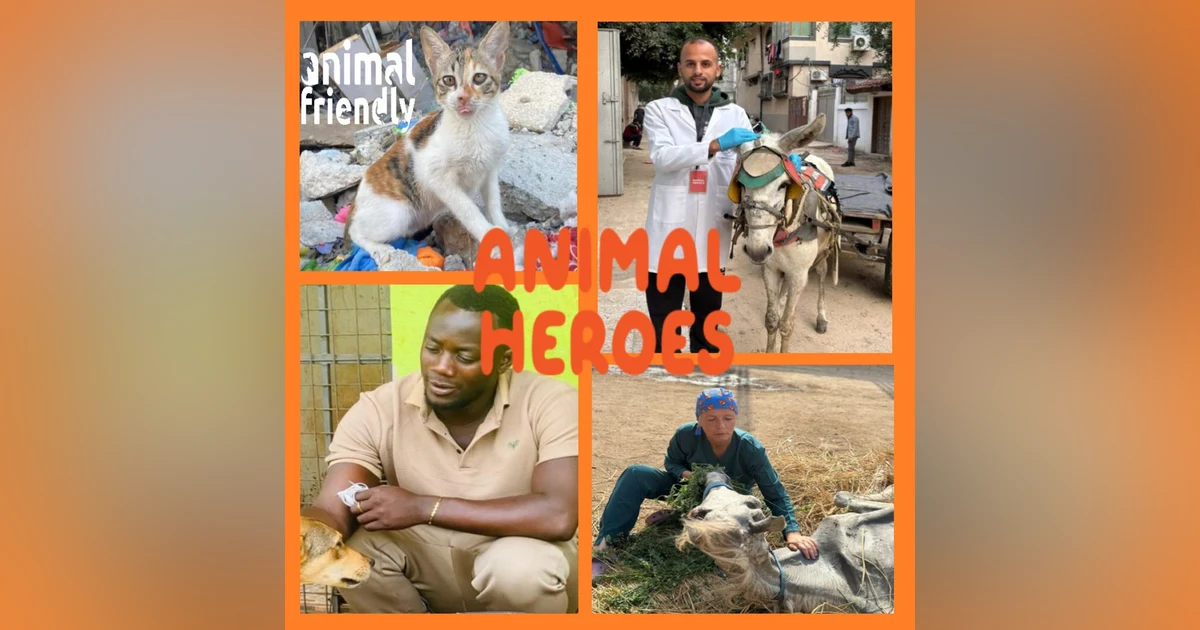
Animal Heroes was founded after Esther Pef met a woman in Ukraine who had stayed to care for the animals that had been left behind during the war. Esther started the organisation to amplify the voices of these people who care for animals in the most extreme circumstances around the world.
With a team of 30 volunteers, Animal Heroes have supported over 40 projects so far and helped over 37,000 animals. From Lebanon to Spain, from the West Bank to Nepal, in countries all over the world, Animal Heroes are there to help the people who risk everything to help injured, neglected or abandoned animals in the most difficult circumstances.
The organisation raises funds to help these local people get the resources they need to continue saving the lives of animals in conflict areas or in the aftermath of natural disasters.
00:00: How Animal Heroes started and how it works.
18:20 - Dr Hosam in Gaza
25:40 - Ellie Lukenga in Uganda
33:00 - Joke van der Post in Egypt
35:45 - Crossing the Italian Alps to raise awareness for pigs
42:40 - Diana Babish in the West Bank.
https://animalheroes.eu/projects/
https://animalheroes.eu/projecten/help-our-medical-response-team-in-gaza/
https://animalheroes.eu/projecten/support-animals-in-uganda/
https://animalheroes.eu/projecten/support-joke-in-egypt/
https://animalheroes.eu/projecten/help-animals-in-the-westbank/
https://www.instagram.com/hosam_vet/
Dr Hosam in Gaza (The Dodo): https://www.youtube.com/watch?v=D5oHH7gUC9w
Dr A'aed, from Gaza to Dublin: https://www.ucd.ie/sustainability/whatsnew/futureleaders/aaedabunejem/
The Dog Scamming Kingpins (BBC Africa Eye): https://www.youtube.com/watch?v=pFnXT8PJfhk
Start a fundraiser: https://donate.animalheroes.eu/en-GB/campaigns
Featured music:
Lion by Sapajou | https://soundcloud.com/sapajoubeats
Royalty Free Music by https://www.free-stock-music.com
Creative Commons / Attribution 3.0 Unported License (CC BY 3.0)
https://creativecommons.org/licenses/by/3.0/deed.en_US
See omnystudio.com/listener for privacy information.
(Music playing)
ESTHER (voiceover): And Ellie Lukenge, who is our animal hero who we support, he has organised a whole network of people who have gone undercover to bring out in the open and to collect evidence against these people so that then the police could arrest them. And then when the police arrest them, he is incredibly brave. When I say animal hero, he is a true animal hero because he risks his life. He gets life threats from these internet gangs, these criminal gangs. They try to run him over twice or three times. It's very scary. He's afraid of his life, but he continues because he cannot see this injustice and he will be there to help any animal in need, as he has done for the past 20 years of his life.
(Music playing)
HOST (Voiceover): Hello and welcome back to the Animal Friendly podcast. Today's guest is Esther Pef, the founder of Animal Heroes. This is an emergency aid organisation that was founded in 2022 and their mission is to support the people who risk everything to help injured, neglected or abandoned animals in the most difficult circumstances, such as conflict areas or the aftermath of natural disasters. The organisation raises funds to help these local people get the resources they need to continue saving lives. They amplify their stories and bring recognition and aid to all those heroes who are protecting animals in emergency situations. So far, they have supported over 40 projects and helped over 37,000 animals. We started by talking about Esther's own story and the origins of the organisation. And then we went through examples of some of the fascinating and vital projects they are supporting around the world.
ESTHER: Well, my name is Esther and I'm from the Netherlands, from Amsterdam, but I've been travelling a lot that I nearly forgot my own language. I've lived in many different places in the UK, in Spain and I'm currently residing in Italy. And actually, since I can speak or since I remember, I always loved animals and I always wanted to help animals when I saw an animal in difficulty. And when I was 12 years old, I started my own animal aid organisation, even though it wasn't official. My dad had his own company and he got his own room in the house. He worked in IT, so I wanted to have my own room and my own company and it had to be something to do with animals. So when I was 12, I started collecting money for the local animal shelter by writing weekly newsletters. I would cycle to the library. Internet did not exist. Yes, I'm that old. And every week I would write something about a type of animal and then I would have a little joke of the week. I would have a photo copied from a book and my father would copy the newsletter like 500 times. And there I would go off the whole week going door to door, selling, illegally of course, selling the newsletter and people would pay 25 cents, 50 cents. And with that money we, well I say we because I recruited some friends from the neighbourhood. So in the end, we were, I think, 10 of us and we collected about 1000 euros, I think, each quarter. And with that money, we bought food for animals. So it started already when I was really, really young. But then, yeah, life happened. My dad thought it was a great idea if I studied business, because if you study business administration, there's jobs. So I just did that because my father thought it was a good idea. I was never that passionate about it, though. I graduated, I did a round of corporates, worked for all sorts of corporates in different industries, never really found my way in that. And let's say about 20 years later, I came back to where I started and started Animal Heroes. It wasn't really a coincidence. I went on a world trip when I was 40. You know, when you're 40, you reach that, I reached that stage where I thought, okay, I have a good job. I worked for myself in aviation at the time. But I really didn't like it. I was bored with it. And I thought, am I going to do this until I retire? So I thought, okay, let's get out of here. I went on a six week tour around the world with my wife. And we saw the most amazing nature. We swam with dolphins in the deep sea ocean. I saw whales in Alaska. I swam with penguins, really in the sea, free, of course. And there, there was this click that I thought, this is what I wanted to do. This is why I am here on this planet. I want to help animals. And then I just quit everything. I just quit my job and started helping animals. I joined a charity in the Netherlands that is an animal welfare organisation. And then the Ukrainian war started.
And I got to go there. And as soon as it started, we were there helping animals. And we raised money to start aid projects there. And actually, there's something, it's something happened that kicked off the start of Animal Heroes. And it's that I saw, I met an older lady in the area of Kiev. And she didn't have heating. She didn't have a place to shelter. She stayed where all her neighbours had disappeared. They ran off to Poland to escape, quite rightly so, as the Russian invasion was nearing. And most people left there, or a lot of people left their dogs and cats behind. And this old lady stayed behind to take care of the cats and the dogs that all the others had left behind. She just had a little pension, hardly anything to eat for herself. But what she had, she shared it with these animals. And her only concern was, how am I going to feed these animals tomorrow and the day after and next week? And I was so touched by her generosity, by a sense of responsibility for animals, and not just for her own life and her own family, that when I came back, I thought, I want to use my skills and my business degree to help people like her. Because the world can only help people like her if they know they exist. A lady like that only speaks Russian and has no clue about social media. And so small as a reality that it's hard to get access from aid from bigger animal aid organisations. So here it was, Animal Heroes. Animal Heroes, two months later, was founded to help animal heroes, people like her, people, and the heroes are people, could be anyone who works or lives in a very difficult situation, works on extreme circumstances, and try to rescue animals. So it started off there. And the idea was that it was going to be something small that I could do maybe one day a week to try to raise some money, maybe get 500 euros a month to help a person in a war zone. And then it somehow took off, it took off on a flight and we've helped over 37,000 animals. We're now a team of 30 volunteers from all over the world. We're specialised in war zones. And we have had more than I think 16, 17, eight projects in over 14 countries. And that all since 2023.
HOST: Yeah, it's incredible. It really is. I was wondering about your origin story. All right, how you started in Ukraine. And I love that, that it started so small, just one person. And then it grew and grew. And you have, I looked on the website and you seem to have a fantastic team.
ESTHER: They're all volunteers. We are all volunteers. I'm the only one who works full time. But also I don't get a penny. I mean, it actually cost me money. But I can do that because I don't have children that need to go to Harvard or so. And I have a wife with a good salary. So we can we can live off that. And she's also really support supports this a lot. So we're doing this together and together with 30 people and everyone brings their own expertise. Most people have a full time job or a part time job and do something extra in their spare time to help animals. Some are on the line or in the field. Others maybe are good at IT. So they help with the website. Other people are very good at social media. I'm hopeless, for example…
HOST: How did you meet your team? Or how did you meet all the people? Just in your friend circle? Or is it people you met as you were travelling? Or how did you grow your team?
ESTHER: It happened really organically. We started off with the board directors of three people, because in the Netherlands, you can choose if you want to start with one person or with three. But if you start with three people, it gives you more credibility, because you comply with different set of rules. It's a little bit more formal, more transparent as well. And I wanted that. So we started with originally with the three of us and with two friends of mine who I know are have a good business head, because you need also someone who understands finance or someone who has some degree of business experience, because it is like running a business.
HOST: Of course.
ESTHER: Yeah, you can't just set it up because you all love dogs or any other animal. There's a business aspect of it to make sure that it can continue and that it can develop. And then the rest, it started organically that people heard about us, read about us in the newspaper, saw us on the news, because the first big project that we did, a project was in Turkey in February, March 2023. Our website was live, but we didn't have yet the bank account. We didn't have people couldn't donate yet because it took like six weeks and the earthquake happened in Turkey. So we went there with the vet and who then became our vet, our private vet. And I said, hey, what do you think about departing to to Turkey and work in a field hospital of the biggest animal rights organisation there? And he said, when do we depart? And I said tomorrow. And he said, OK, let's go. So that's how it started. And we had a lot of media coverage. And because of that, people approached us to say, can I help? Can I join your team? So, yeah, organically, people, they contact us to ask if they can do something. And if we sometimes we have a vacancy, we put it on LinkedIn and people can apply and we have a whole process application process.
HOST: You I think you seem to have… my understanding is you kind of have a team on the ground in each area and then you coordinate or that you and your team then coordinate the vets or the personnel on the ground in each area. Is that kind of how it works or do you guys travel?
ESTHER: Yes, it depends on the type of project like we have in in Gaza, for example, and in the West Bank, we run our own clinics. We have emergency veterinary clinics that are really our own clinics. We pay the rent. We buy the equipment. The team that works on the ground, they are our volunteers. So they're really animal heroes and volunteers. But that's kind of an exception because normally the aid projects are temporary. So what we normally do if there's an earthquake, we look at who is doing the work on the ground. We always work with local organisations if we can, because they are eyes and ears. They know their territory. They know exactly what's needed, because the last thing you want is to just go and help without knowing what help is actually needed. And you saw that a lot when the when Ukrainian war started, people were bringing all sorts of clothes to the border. And a lot of things that these people actually turned out never even needed. They needed other things.
They needed sanitary towels for women. They didn't need winter coats because they had them there. So it's very important to really understand what is the crisis, what is available and what is needed the most. And based on that, we always look at what OK, they need this and that. And can we offer that? Because sometimes we also have to say no, we can't offer everything that maybe an organisation needs or a situation demands. Like, for example, we've been asked to help out with wild animals in a particular country. And we have to say no, because dealing with wild animals, you need to have that experience. Otherwise, you do more harm than you can do, than you can actually help. So in a situation like that, we try to collaborate with other organisations who are specialised maybe in bears or tigers. So we always work with local heroes on the ground. It could be an animal rights organisation. It could be a shelter. It could be an old lady by herself. We're flexible on it, as long as it's emergency aid where we can actually make an impact. Like, for example, Venezuela, we asked what is needed here?
HOST (Voiceover): Here Esther is referring to the devastating earthquake in June 2026, which resulted in thousands of people dying and many more living in displacement sites or sleeping in tents next to their destroyed homes. While there were many humanitarian organisations rushing in to help the people, the animals needed help too.
ESTHER: Because we have a field hospital. And if they need the field hospital, we can actually ship the field hospital. And we can go there because we don't just send our field hospital. Then we have our people to go and build it and set it up. But then we learned that they actually have a building, but it was leaking. So they asked send us people to actually fix the building. And I thought, well, how about we recruit local people who can actually fix the building, rather than flying people from the other side of the world in to help fix a building? So we really try to understand what is needed and how can we make an impact that makes each euro count.
HOST: Yeah, I love that, that you are actually thinking where can we save money and also what's the most efficient and useful way to do something. Really a lot of thought gone into it.
ESTHER: Yeah, like Nepal is our latest project, the devastating floods there. The situation is really horrible. There's no point for us to fly to Nepal. There are many organisations on the ground that know their territory, speak the language, and they can move there because they know the territory. They know how to get there. They have the networks that are needed and required and the collaborations with the local governments to do what they do. But what they need is money. And in this situation like that, we work together, if we can also with other organisations, like on this particular project, we work together with World Animal Protection and with another Dutch organisation, which is called Stichting Dierenhout. And together we put funds together and we together raised 40,000 euros. Obviously, with that impact, you can do much more than if each organisation brings their own. So it's one centralised effort, which also means there's only one point of contact for these people there in Nepal rather than three, four, five different organisations. So we try to collaborate also in a very pragmatic way to not do double work, to save money, also on bank costs even. Every time we send money outside of Europe, it has a cost. So we put ourselves together and we say, we send the money to you and you send it all together to Nepal and we save 25 euros. It's only 25 euros, but still.
HOST: Yeah, that could be one person's donation that you saved.
ESTHER: Exactly. So we really try to not spend money in a way that it does not go to the animals. We do the opposite. We really try to save and think like pragmatic on how can we make sure that every year really goes to the animals.
HOST: Yeah, I do love that on your website. Your website is really attractive and appealing. It's very easy to get around.
ESTHER: Oh, thank you. I'll pass it on to the website team.
HOST: It is. It's so easy to navigate. And I really love the way you kind of say, these are the projects, explain about them. People can donate to specific projects or they can just donate in general. And the way you say, you know, then we'll tell you about where your money goes. And I did read, you know, 100% goes to the animals. And I was kind of wondering, gosh, how do they do anything? But now I understand, you know, all the volunteers do everything yourselves.
ESTHER: Well, it's not the case that 100% of every donation for every project goes to the animals. It depends on the project. For each project, we have a frequently asked questions where we specify how much of your money goes to the project. Because we have some projects where we say, OK, it could be that maybe up to 10% or 15% max is used to cover our running costs, because we do have the bank to pay. We have a virtual office. That means we need software so that we can communicate with each other, which is still a lot cheaper than actually renting an office with walls, of course. So there are costs, donation platform costs, so that we definitely have some costs. But mainly they are covered by specific donations that cover those. So like some companies give a donation specifically for that.
HOST: Yeah. How is the communication with, I was just thinking, because I'm following Dr. Hossam in Gaza, and I was just wondering, how do you communicate with him, for example? Or is the internet fairly universal? Is it easy enough to communicate with people, or do you have difficulties getting in touch with people?
ESTHER: Sometimes it's difficult. Dr. Hossam, like anyone in Gaza, they have problems with electricity and Wi-Fi, so they don't have internet all the time. But we manage to speak on a daily basis, usually. Not always, like this morning, he texted me, and then maybe he's offline for a few hours. Obviously, there are many struggles. So like, for example, the other day, he was offline for a few hours because they had to set up their winter tent. Now we go in a tent when we think, okay, let's go back to nature, and in five days somewhere, we put our tent and we're on holiday. But most people in Gaza live in tents still, because that's the only way they can live. And it's getting colder there, when it rains, it gets all wet, it's humid. So sometimes we forget. Every two weeks, we have team meetings with everybody, the whole team. And because it's voluntary, and I also think meetings should be kept to the minimum, because time is always very valuable. People in our organisation can choose if they want to attend the team meeting, or if they don't want to do that. And they can also choose if they only want to participate in the first half an hour, which is where we give an update on everything that happens. And then in the second half an hour, we have a special topic. Could be something to up for discussion, or to ask maybe opinions, or could be some special theme. And sometimes when we really have nothing, we just say, okay, this meeting is only half an hour. So Hossam is always there. Before Dr. Hossam, we had Dr. A’ead. He started the clinic in 2023. And at that time, we always had the drones on the background, the drones that were bombing. And it happened a lot that he just had to go off and run for his life, or he would get an evacuation order. We got used to it. The first times it was very shocking. But after a year of hearing the drones, it became nearly normal to hear the IDF drones on top of his camp. Now I don't hear the drones anymore, even though there's still bombing happening. Dr. Hossam went to the north of Gaza to help someone with an injured cat, and to provide food there. And it was very dangerous. And suddenly out of nowhere, there was a lot of bombing happening there just a few weeks ago. There's a lot of difficulty still with continuing also the aid. He does it, but we're still always scared that something might happen. Yeah.
HOST: Do you, as you said, is it mostly food that people, or is it food or medicine, or is it a bit of everything? Do you give the money and then trust the people on the ground to decide what they need to spend?
ESTHER: Well, it's Hossam. We trust Hossam. We've never met Dr. Hossam, because we have not been to Gaza ourselves. But Dr. Hossam was already in the team of veterinary doctors when Dr. A’aed was still there, our first colleague. And how we work when we cannot meet someone personally, and we have limited ways of checking references and due diligence, which our due diligence process is very strict, because we operate in war zones. So we also have to check sanctions lists to make sure that we don't deal with terrorists, that money really goes to animals. And that's also the reason why we get support from very big organisations like Humane Society or World Animal Protection, because of this very thorough and strict due diligence process. And what we do when we have a new doctor or a new, even an external person, we start with small amounts of money and see what happens. So we trial and error, maybe give 500 euros and we see if we get photos back, we want to get feedback from people that actually got received the aid. And then gradually we build it up. So we've been working with Dr. Hossam now for a year, nearly, because Dr. A’aed managed to leave Gaza and he's now studying in Dublin, actually. And he's doing a Masters in Dublin. And Dr. Hossam is fantastic. So he has now our full trust, and every month he gets a monthly fee for paying the rent of our clinic and also to buy food and medicine. And then he decides how to spend it. So we receive about 20, 30 messages every day from people, citizens in Gaza, asking for food, asking for medicine. And we reply, please contact Dr. Hossam because he knows who has already received what, he keeps track of it. So we don't interfere with that. It's Dr. Hossam that does that. And he himself has a Dutch team of veterinary doctors that follow him and where he can go for advice also if he has complicated cases.
HOST: It's so interesting. I didn't actually realise until I was following him how important the donkeys are out there.
ESTHER: Oh, yes.
HOST (Voiceover): In war zones where bombings, displacement, hunger and disease are everyday occurrences, donkeys in particular become a lifeline. When roads are reduced to rubble and fuel is unavailable for vehicles, having a donkey and cart helps people to evacuate safely and carry belongings and necessities. Caring for the donkey becomes extremely important. So we can see how busy and necessary a vet becomes in these circumstances. Dr. Hossam was also featured in a short video made by Turang Panchal for the Dodo.
HOSAM (Voiceover): Growing up with the pets taught me mercy, but I also realised that animals don't have voice to speak and to show their pain. I become a vet to be a voice for them. I become a vet to be a voice for them. I volunteer to provide free treatment and make food stations for animals. My experience as a vet in Gaza crisis was not similar as a normal human because I have a duty toward these animals. When I saw animals suffering from lack of treatment, lack of vaccine, lack of food, my duty to do any help for this. I would like my voice reach all people around the world and I hope also support me to change situation here for animals and enter the drug and vaccines for all type of animals here in Gaza.
HOST (Voiceover): You can find Dr. Hossam on Instagram at Hossam_vet. Because Animal Heroes covers so many different projects, I wanted to make sure we got a taste of all that variety, so we moved on to another country.
HOST: But I just I wanted to move on to another project, the one in Uganda for the fake rescue dogs. Now I did see this a few months ago or whenever it happened that they closed down the rescue day, the fake rescues, and they rescued all the dogs that they could. Now somebody is looking after all of those dogs?
ESTHER: Well, that's at the same time it's a problem, of course, because this gentleman is called Ellie Lukenge and he runs Uganda Animal Lifeline Shelter, which is one of the few registered charities in Uganda. And he works together also with a lawyer who is behind most of these, let's say, police activity related to arresting criminal gangs. It's really an organised criminal gang that opens, starts fake shelters. And these fake shelters, they're so horrible because they go around picking up animals from the street and they wound them on purpose. They cut, they make, they create wounds in the, they inflict wounds on the dogs and then make pictures and ask for donations. So it is, it is evil. I don't have any other words for this. This is purely evil. And Ellie Lukenge, who is our animal hero who we support, he has organised a whole network of people who have gone undercover to bring out in the open and to collect evidence against these people so that then the police could arrest them. And then when the police arrest them, it is, I mean, he's incredibly brave. When I say we're animal heroes, he's a true animal hero because he risks his life. He gets life threats from these internet gangs, these criminal gangs. They try to run him over twice or three times. It's very scary. He's afraid of his life, but he continues because he cannot see this injustice and he will be there to help any animal in need as he has done for the past 20 years of his life. So the good thing is that now I think about 13 people have been arrested. Quite a few of those shelters, about seven or eight shelters have been closed down and these animals have been rescued and they are now sitting, most of them, in the shelter of Ellie Lukenge, who already struggled to make the ends meet. So we facilitated the rescue. We paid for the new kennels and paid for food and vaccinations because these dogs that come into the shelter cannot join the other dogs because they need to be in quarantine because they need to get the rabies vaccine. Some still can get babies, so they need to be sterilised. And these are incredible additional costs. So now he finds himself in a situation where he has 100, 200 dogs extras and he cannot make the ends meet. He runs out of food. And the sad thing is, in Uganda, so far away from Europe, it's never in the news. There's no earthquake or there's no war for which it's in the news. So we don't get many donations for Uganda. And we would really love to have more donations for Uganda also because the money really goes far. It's so cheap that with just, you know, 100 euros, they can feed like 10 times more animals than in any other place. So it's incredible what he does. We are actually going there next year. We're going, paid by ourselves, on a holiday that we're going to combine with seeing the gorillas. We're going to a natural park. But we're going to meet him personally and hope to get some media attention then. That will also raise some more awareness and donations, hopefully.
HOST: I know, I guess, because I'm following the news there. I thought it was a huge, big story. And but as you say, it doesn't reach European or you don't know when you're outside of the animal circle. It was a very big news in animals.
ESTHER: Well, actually, the BBC published a short documentary about it months ago. They were the first one to publish. Thankfully, they did. They published something really, really good about it. But we want to make sure there's going to be more media attention also to protect people that want to donate, because there's still so many people who donate to these fake shelters. And it's always better to donate through a registered organisation because there's more scrutiny. It's a little bit more difficult. If you really want to do something illegal and steal the money, you have to go through a lot of more steps in order to do that. If you register, even in Uganda, because it's a lot of paperwork, it's a little bit safer.
HOST: Yes. And of course, it's so easy to tug on people's heartstrings. And that's what they were doing. And so that's why I really like to promote legitimate funding and people like you. How do you go about getting your funding? Is it just kind of on social media? Is it just getting your name out there?
ESTHER: Yeah, it's a combination. We are fully dependent on donations. We don't receive government support. I don't think any organisation in Europe does. We get support from bigger animal aid organisations like World Animal Protection. They support us for certain projects. And they say, hey, Esther, we have some spare money here, can we give it to you for Ukraine? Or sometimes we do some joint projects with them and other organisations. But mainly we are dependent really on families, on private donors, animal lovers. So we can do only what we can do. Our limit is the funding. It's how much funding we have. And we do something also that's quite unique is that we really say you can choose as a donor where you want your money to go. So if you want the money to go to, let's say, deers in the forest in Avila following the forest fires, then it will go there. And that's it.Then we have a little clause that if for some reason we cannot spend it there anymore, because we spend enough of the project, the animals are fine, they don't need it anymore, then we can give it to a similar project. And that is for a simple reason that we don't have the time to start emailing hundreds or thousands of donors to say, sorry, we still have a thousand euro left. Is it OK if you can't do that? But we then spend it to a similar project. But the money will go first and foremost to the project that someone chooses to. So sometimes we have money that is sitting in one project and there's a lot. And then there's another project like Uganda that has very little money relatively. And that means that we can only do what we can because it should be like that. The donors decide it's their money and it should be them deciding where their money goes.
HOST: I do love that aspect of the website and I really enjoyed browsing through the different projects. I think you do a great job of telling the stories and quite a few of them I would have been familiar with, but I think there was one, there's a lady working with horses, Joke in Egypt.
ESTHER: Are you familiar with Joke?
HOST: I wasn't. I am now.
ESTHER: Joke became famous in not only the Netherlands, but also in England, actually. She was also in all sorts of British newspapers and on TV in the news because a video of her went viral in Egypt where she hit a boy, or, a man who was mistreating, he was abusing a donkey, was kicking a donkey and she just came in and hit the guy. And it went viral and she became a national hero. She's Dutch and she grew up with a family who had a shelter for animals. And she owns, well she doesn't own them, but she rents stables in Egypt next to the pyramids and she buys horses that are too ill or too old or too young to do the heavy work because there's a lot of animal abuse there. Because the tourists like to go on a donkey and they carry it around and these donkeys are not treated really well, most of them. So they have a lot of wounds, they get tired, donkeys and horses. And then she looks after them. She has her own clinic with vets and the people, the owner of the donkeys and the horses come to her for free medical care. And so she treats about 100 donkeys a day on busy days. And when they are just too tired, too old or too young, she buys them off the owner and takes them into care. And I think she has six different shelters now and that is pretty amazing what she does.
HOST: And she gets a lot of abuse and I think I read that as well, that she kind of has a bit dangerous, you know, people are not happy with what she's doing. A lot of people are.
ESTHER: Yes, sometimes she shows up with a blue eye or a broken nose herself or she ends up in jail for a fight and then gets released again. It happens. But she's quite a fisty person and very vibrant and she does anything in her power to protect animals. So she's doing amazing work in Egypt and she's now thinking of going into Pakistan, because also in Pakistan there are donkeys that are being abused. So she's looking into that as well.
HOST: That is a lovely segue into another tough, strong woman. That's you and your wife. I want to hear about crossing the Italian Alps. So you did this for pigs?
ESTHER: Ah, yes, that is nothing to do with Animal Heroes because it's something we've done just before Covid. So Animal Heroes didn't exist yet. Yes, we wanted to raise attention in Italy about the conditions of pigs in intensive farming because we were getting very irritated going into the supermarkets and seeing pictures of happy pigs walking on the Tuscan hills on meat products. It's false commercials because actually what it shows is like, look, these are very happy pigs. They're walking around freely, whereas most of them, well, probably 90 percent. I don't know exactly the percentage, but most of these animals never see the daylight because they come from intensive farming. And a lot of them come from the Netherlands, actually. We are in the Netherlands, the butcher, actually the butcher of Europe, the slaughterhouse of Europe. I think we kill around 12,000 pigs an hour, I think. So it's huge. And a lot of them actually go to Italy to then end up in salami and prosciutto, the hams. So I wanted to show that to the Italian people that what they're so proud of, of being their Italian product and what's called quality meat actually came from animals being really mistreated and abused in horrible conditions often. Not always, but most often, yes. And now to get media attention. Yeah, I mean, we thought, OK, we can try to run a marathon, but apart that I'm not a good runner and my wife isn't a good runner either. It's not really newsworthy. There's so many people that cycle up a hill or a mountain or that go running. So we thought, what can we do that nobody else has done yet? And now we have a friend who is a world champion, used to be a world champion cross-country skier. And we just came up with the idea of let's go and cross all the Alps in Italy from west to east. And then we thought, oh, that could be a very, very interesting challenge. And it turned out to be very successful because we were on all the news stations. We got a lot of media attention in Italy. And a lot of people were so angry because the Italians didn't know that the Dutch pigs landed in their Italian salami. And that also in Italy, actually, the animals were not better off, that they were also living in these hellish conditions. So people started to think about it a bit more because a lot of people in Italy, when they say, I don't eat meat, they still eat ham and salami. And they don't even realise that that is meat. And that means that it comes from an animal that once lived. So it does help to create some awareness, but it's very difficult to see any impact in that.
HOST: I know, I know.
ESTHER: Yeah, we did a thousand kilometres on cross-country skis.
HOST: How long did that take?
ESTHER: 36 days.
HOST: (laughing)
ESTHER: And then when we, when we finally arrived, you know, these are these things that when, when you think about it, you think this is a great idea. And then, and then once you're on like day four, with every, that every muscle, that there's muscles in your body that hurt, that you didn't even know you even had muscles there. And you think, why am I here? Why am I doing this? But it's, it was a very special experience, because we met so many amazing people. In one village, we had the mayor that gave us something like a trophy with something written like your first mile of for a good cause. We had whole villages where everybody came out to clap when we arrived, because all the news was following us, the media was following us. So it created some kind of a vibe where people along the, along the, the way that we're standing there with bells and clapping. And we never expected that. And we hardly had to pay for the hotels because people offered us accommodation. So we came home, we made a lot of friends. And then we came home. And the day after we were all locked in because of COVID.
HOST: Oh, wow.
ESTHER: Yes. And in the end, we raised also some money. And with that, a documentary was made in the Netherlands about, about pigs and their intelligence and how they are. So it was, it was a nice project. And the difficulty was that the skiing was actually in the end, once we got into it was the easy part. But, but then after like 40 kilometres of skiing, so the whole day skiing, where you didn't have the time to sit in a bar and have a nice drink. It's just to go, go, go. Then the day started because I also still had some freelance work that I was doing. So in the evening, I had to pick up the freelance work. And we had interviews with journalists. And we had to meet mayors and people. And so it was very intense. But, but also, it was a, it was very special. And I, and I will never do it again.
HOST (laughing): Yes, you don't have to now you've done that. That's so interesting, because I imagined it. I imagined you were alone for 30 days that you were away for isolation. I didn't imagine this going to villages and stuff. That's a lovely picture. But yeah, almost much harder work, talking.
ESTHER: Yeah. And if I can let you in, in a small sort of family inside, a little secret…well, it’s not really secret. But you know, when you live together, sometimes you maybe have arguments at home. But we were skiing every day. And at some point, we had an argument and I was angry. And I couldn't, you know, you walk out the door, you slam the door. I couldn't because…so I remember once I was angry with my wife about something. And then I just start to ski away from her, which obviously I couldn't because she's better than me. Then I can't go anywhere (laughing). No. But that was a very, it was a very unique experience. And now I know all the ski resorts of Italy. So if any of your listeners would like some advice on where to go do cross country skiing, here I am know them all.
HOST: Okay, so I just I wanted to get that in. But let's go back to animal heroes. Is there anything in particular that you would like to talk about that you don't kind of get asked about or that you think is a really priority for people to know?
ESTHER: I think the West Bank, obviously, all our projects are urgent. They're important because we're an emergency aid organisation. So we only have urgent projects. But the West Bank is really escalating the situation there. Not only for animals, of course, mainly for people as well. We support we have two projects, actually three projects there. One is in Bethlehem, where a lady called Diana Babish runs the only registered shelter for dogs and cats. And she is in a very dire situation that all our funding is dried up. In her shelter, there's over 200 dogs now. There's hardly any people that adopt these dogs, because normally she finds ways to get them also through to places and families, all inside of Israel, West Bank, or abroad, even America. But because nobody travels there for tourism anymore. So nobody takes the dogs home. And she has a lot of extra cases as well of injured animals, injured stray animals, that at the moment, she cannot pay for anymore, because she doesn't have any donations. Now we support her, but it's also limited what we can do. We've been there three times. The second time we were there, it was when the first Iranian bombing started. It started an hour after we landed in Tel Aviv. So we actually saw the first missiles landing on top of Jerusalem, which is really close by. And ever since, it's actually just gotten worse and worse and worse. So if there's anyone who has any ideas on how to find support, financial support for Diana in Bethlehem to help her feed her animals, you know, provide the vaccines, everything needed for medical care, I'm happy to hear, because it's really needed. She's the only registered charity with so many animals that she's helping. And she just is finding herself in getting more into depth. So we're trying to find a solution for that. And at the same time, we run our clinic in Jenin, that's the north of the West Bank. It's a clinic that is run by Dr. Mohamed already now for one and a half years. And the situation is difficult for him because there's a lot of violence from settlers. So it's very dangerous for him to cross the street. There is the IDF in the city. It's very difficult because there's more and more checkpoints, so they cannot travel easily anymore. And the situation is getting worse and worse throughout the West Bank, not just for the people, but also for the animals. So if there's anyone who has any idea or who would like to support animals in the West Bank, then we would be really happy. And 100% of every euro goes directly there. Thank you for that.
HOST: Yes. When I was kind of listing down the projects, I was like, OK, we can't talk about all of them. So I will pick out a couple and then I will ask her to pick out some. So that's perfect. That's wonderful.
ESTHER: Thank you very much for this and for giving attention for the animals in war zones.
HOST: Of course. Thank you for the work. I'm really, really thankful. I'm just so happy for what you do. And it's so interesting and you do such a wonderful job. So it's absolutely my pleasure to talk to you and find out more about it.
ESTHER: And yeah, just let me know when it's coming out and we'll share it on our socials as well.
HOST (Voiceover): If you are interested in finding out more or just having a browse around their lovely, friendly, uplifting website, you can find them at animalheroes.eu. As mentioned, you can choose which projects you would like to support. But having talked to Esther, I think I would choose the button that says make a general donation and trust the organisation to put it to best use. You can find the projects at animalheroes.eu forward slash projects. They also have a facility if you want to do a fundraiser and they give you some ideas like a sports challenge or selling your art. And they'll open a special page for your campaign, which you can use to publicise it and raise funds for this great cause. So once again, that's animalheroes.eu. My thanks to Esther and all the team for this chance to explore their world and hear about their amazing work. And thanks to you for listening. I hope you enjoyed it. I'll see you next time.
(Music playing)